Reference-based sketch colorization methods rely on large paired datasets that preserve both the structural
and stylistic characteristics of hand-drawn artwork. However, existing datasets are limited in scale,
expensive to annotate, and bound to fixed, often inconsistent artistic style biases that propagate to
downstream models and limit cross-domain generalization. We present TexSketch, a controllable procedural
framework for generating colored-sketch datasets with programmable artistic styles via geometric analysis
and shader-driven stylization. Our fully automatic pipeline integrates region extraction, semantic color
prediction, and shader-based rendering. By defining artistic appearance procedurally rather than inheriting
it from a static corpus, TexSketch enables scalable dataset generation without manual annotation or artist
supervision. Human studies demonstrate that TexSketch generates perceptually plausible colored sketches with
high stylistic diversity, providing a controllable, scalable source of synthetic supervision for sketch
colorization.
Overview
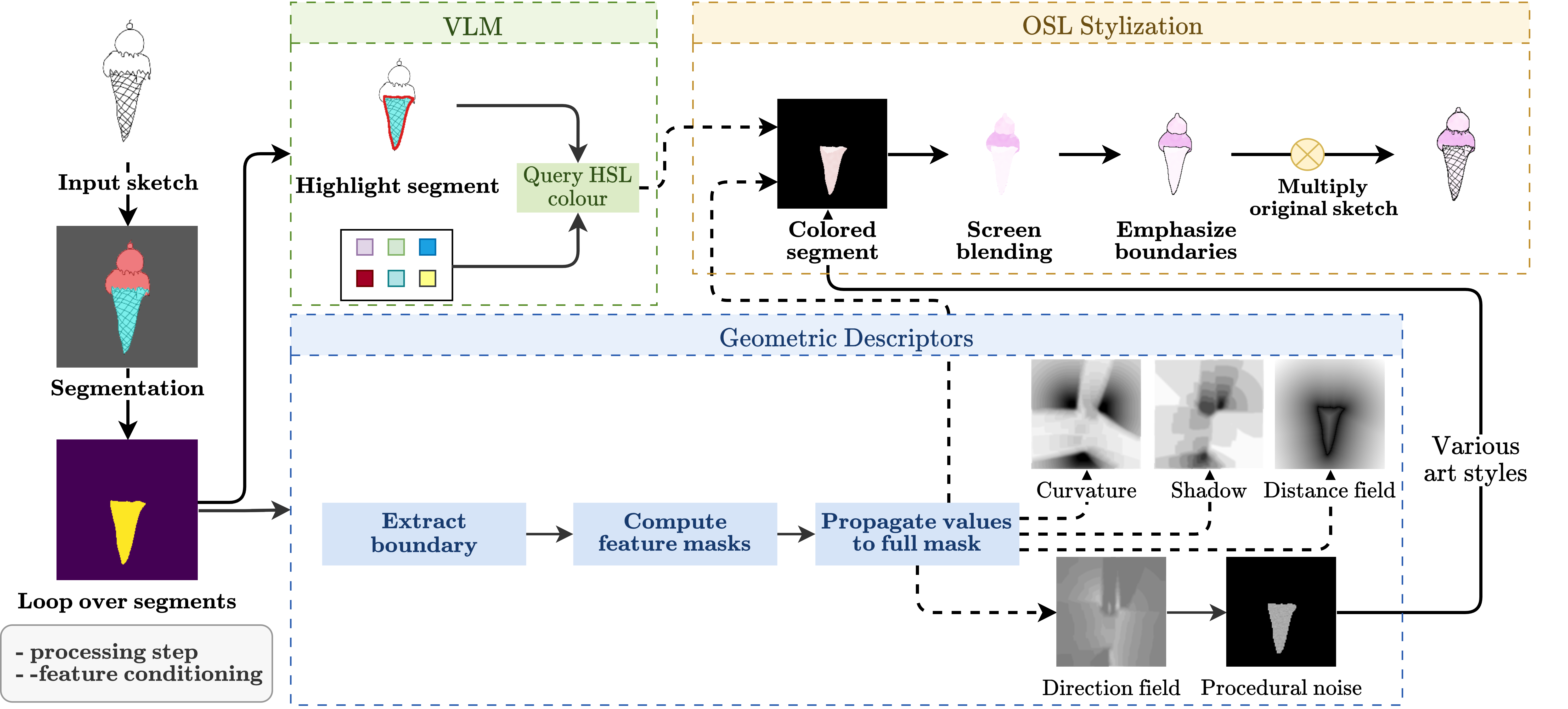
An overview of our method. Our method involves the following steps: (a) Segment an input sketch. (b) For
each segment, figure out its likely hue by overlaying the segment on the image and querying a VLM. (c) Run
the procedural framework to get geometric information and affect the color. (d) Finally, combine all
textured segments and run post-processing.
Colorization Results
Comparison of TexSketch with Colorize Diffusion XL on five input sketches. Drag the
handle to compare. Note: ColorizeDiffusion always returns images in 512x512 while our method is resolution independent. The images you see below are truncated to fit within 512x512 pixels.
Style Controllability
TexSketch preserves the input sketch while allowing the rendered appearance to be
controlled with different styles. Drag either handle to compare all three styles side by side.
Citation
@misc{texsketch,
title = {TexSketch: Bringing Texture-Aware Colorization to Sketches},
author = {Mittal*, Taraash and Rai*, Gaurav and Sharma, Ojaswa},
note = {* denotes equal contribution},
proceedings = {19th European Conference on Computer Vision - ECCV 2026}
}
Acknowledgements
This research work is supported by the Center for Design and New Media (A TCS Foundation Initiative supported by Tata Consultancy Services) at IIIT-Delhi, India.
@misc{texsketch,
title = {TexSketch: Bringing Texture-Aware Colorization to Sketches},
author = {Mittal, Taraash and Rai, Gaurav and Sharma, Ojaswa},
year = {2026},
note = {* denotes equal contribution},
proceedings = {19th European Conference on Computer Vision Workshop - ECCVw 2026}}